KEMAR Dummy-Head Microphone
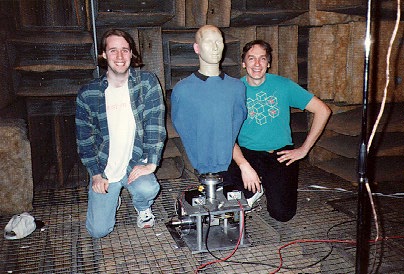
Keith, KEMAR and Bill
The dataset includes three subsets: left ear, right ear and compact. Each set contains stereo responses for various elevation and azumith values. Left and right ear of KEMAR was shaped slightly differently (normal and large red, respectively) to obtain two independent sets of measurements from a single head, rather than having symmetric impulse responses by having the exact same pinna for both ears. The last set, compact, contains a set of normalized responses with a reduced length, for faster processing, taken from the left ear.
|
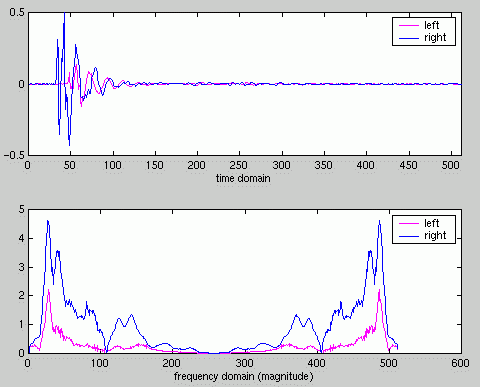
This response is from the case with azumith of 40 degrees (clockwise from "front") and elevation of 10 degrees up. Right ear response is stronger as expected, and overall response seems lowpass as the elevation is fairly flat. |
|
|
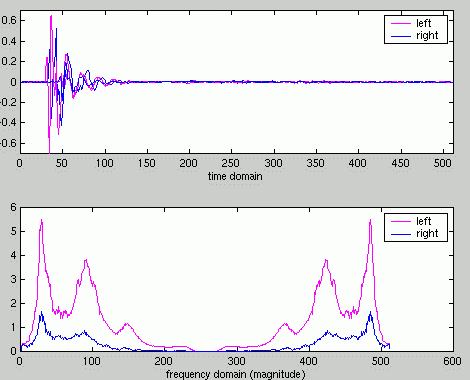
This is the case with azumith of -80 degrees and elevation of 50 degrees. Left response is definitely stronger, and the responses have more middle-to-high component for high elevation. |
Here is the script.
The script generates a wave file with sampling rate of 44.1kHz.