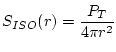
 that is radiating
isotropically
(i.e. uniformly in all directions).
Then at a distance
 the power is spread
uniformly over the surface of a sphere
and the power density (in
 ) is
 , then

 .
Then
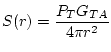
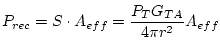
 and the receiver antenna has an effective area of
 then
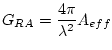 .
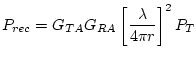
Plugging this into the previous equations gives us the
Friis equation:
At the beginning of the semester, our Grand Plan
called for a wireless communication system
based on optical signals.
However, the factor of  in the Friis equation
suggests that light waves, with wavelengths of a few hundred
nanometers, would be at a considerable disadvantage with respect
to radio waves, with wavelengths of several meters.
Indeed, our first attempt at optical communication in Part 3
of Experiment 2.3 had rather poor range.
However, the fact that antenna gain increases inversely with
suggests that a receiver antenna (i.e. a lens) of a few centimeters
diameter would put us back in the running.
But remember that high gain means narrow beamwidth, so such an
antenna would require very careful alignment of the transmitter
and receiver.
Experiment 2.3 pointed out another potential problem with an optical channel: our optoelectronic devices are nonlinear in their relationship between voltage and intensity of light. In Experiment 4.3 we were able to linearize the photodiode by using a transresistance amplifier, and we can linearize the LED with a transconductance amplifier.