and
and  .
We have also absorbed the reflected moment of intrtia of the gears
and motor armature into
.
We have also absorbed the reflected moment of intrtia of the gears
and motor armature into  .
.
The figure below is a schematic of the position control system.
As a simplification we have omitted the gearbox and absorbed its
effect into the values of
and
.
We have also absorbed the reflected moment of intrtia of the gears
and motor armature into
.
![\includegraphics[scale=1.000000]{scan8.1.ps}](img241.png)
This translates into the following block diagram
![\includegraphics[scale=0.500000]{ckt8.7.ps}](img242.png)
 (i.e. assume there are no weights on the hook and
that the weight of the cord and the hook are negligable).
Then the motor, gearbox, and drum can be modeled by the
first order transfer function
(i.e. assume there are no weights on the hook and
that the weight of the cord and the hook are negligable).
Then the motor, gearbox, and drum can be modeled by the
first order transfer function
 .
Integrating the angular velocity
.
Integrating the angular velocity  to give the shaft angle
 corresponds to the transfer function
  .
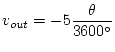
Finally the mapping of the shaft angle into the potentiometer
output voltage
.
Finally the mapping of the shaft angle into the potentiometer
output voltage  is given by
  .
Putting it all together, we have the following block diagram for
the closed loop control system:
.
Putting it all together, we have the following block diagram for
the closed loop control system:
![\includegraphics[scale=0.650000]{ckt8.6.ps}](img243.png)
Previously we have used another motor as a tachogenerator to
measure speed.
We will be using a type of variable resistor known as a
potentiometer
to measure the angle of the gearbox output.
A
potentiometer
(or
pot
for short)
is a fixed value resistor with a third, movable contact
or
slider
which may be positioned anywhere along the
resistive element.
If we represent the position of the slider by
 , where
varies between 0 (fully counterclockwise)
and 1 (fully clockwise), then the resistance between the lower
end of the resistor and the slider will be
, where
varies between 0 (fully counterclockwise)
and 1 (fully clockwise), then the resistance between the lower
end of the resistor and the slider will be  and between
the slider and the upper end will be
and between
the slider and the upper end will be  ,
where
,
where  is the total resistance of the potentiometer.
If we connect the two fixed contacts to a voltage source and measure the output between the movable contact and one fixed contact, we get a variable voltage divider:
![\includegraphics[scale=0.650000]{pot1.ps}](img244.png)
Then the output is

The potentiometer we are using is a
10-turn
pot, which means that ten turns
( )
of the shaft are required to go from
)
of the shaft are required to go from
 to
to  .
We will be using -5 V for
.
We will be using -5 V for  , so
, so